

IT infrastructure migration is not a “one-click” hypervisor replacement. Transitioning to a hyperconverged platform, such as vStack HCP, requires taking inventory of current systems, designing the target architecture, and carefully migrating workloads. At the same time, the process itself can be made manageable and predictable: a phased approach allows you to mitigate risks, test hypotheses, and only then migrate critical services.
As a result, the company gains a unified infrastructure framework where computing, storage, and networking operate as a single system—independent of a separate SAN and with simpler operations.
Why Companies Are Considering the Transition
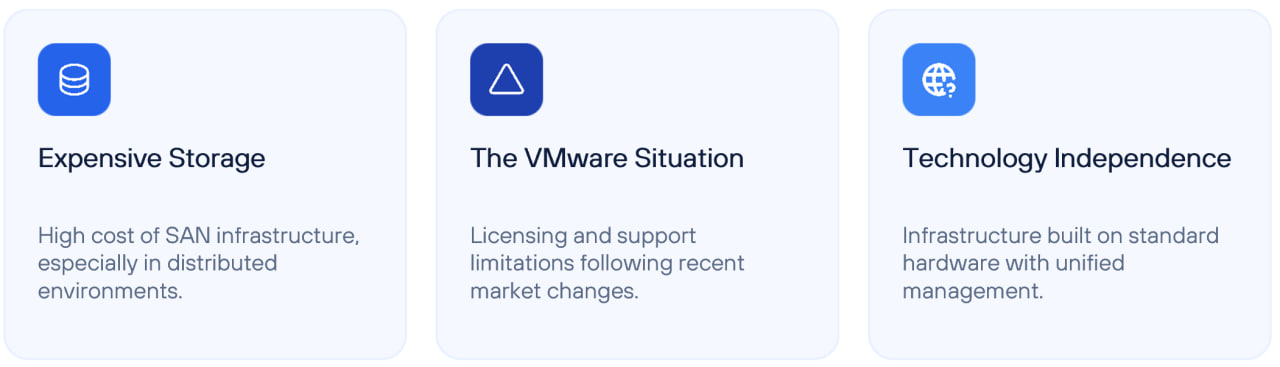
The main driver of migration is the increasing complexity and cost of traditional infrastructure. The classic “hypervisor + SAN + separate management tools” model requires significant expenses for both procurement and support.
An additional factor is the high cost of storage, especially in distributed infrastructures. Using an HCI approach with local disks reduces dependence on SANs and improves fault tolerance without complicating the architecture.
VMware is a special case. Following market changes, many companies have faced licensing and support limitations. Against this backdrop, vStack is viewed as an alternative: it is a platform that unifies compute, storage, and networking into a single software stack.
Additionally, for a number of organizations, independence from imported hardware and the ability to build infrastructure on standard equipment with unified management are critical—especially in distributed and branch office scenarios.
Important: This is not simply a replacement of the hypervisor.
vStack HCP is not “just another hypervisor” but a full-fledged hyperconverged platform. In it, computing, storage, and networking are implemented as software-defined components:
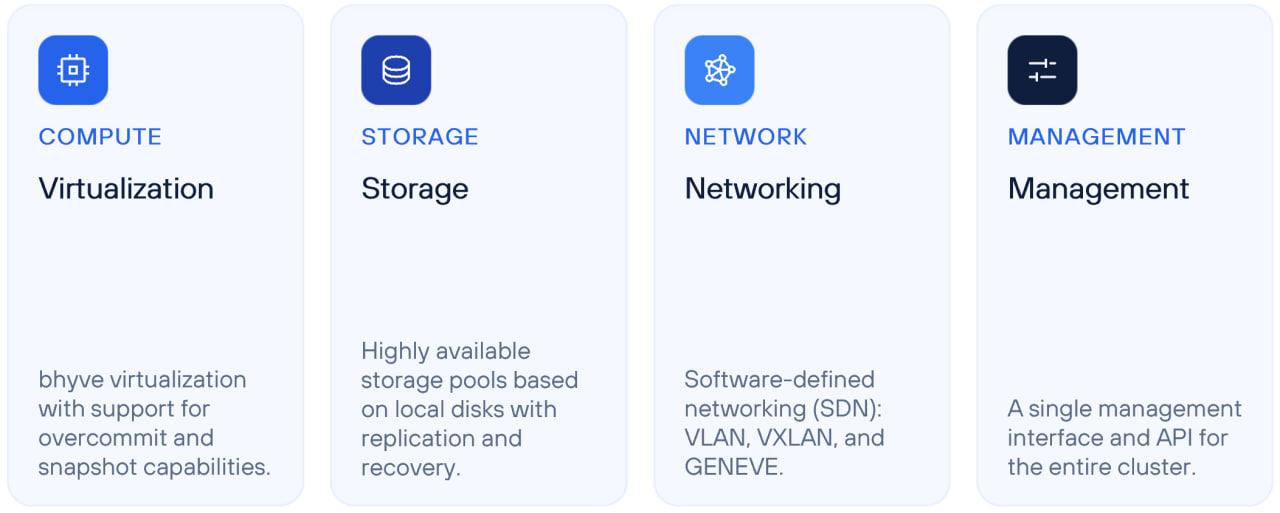
This means that the architectural model itself changes during migration. The company is moving away from disparate components and transitioning to a single cluster that scales horizontally and is managed centrally.
Where Migration Is Most Effective
In practice, vStack performs particularly well in several scenarios.
First, itisideal fordistributed infrastructure and branch offices where using a separate SAN is economically or technically impractical. An HCI cluster on local disks allows you to deploy a fault-tolerant platform at each site and manage them centrally.
Second, service providers and IaaS platforms. The pay-as-you-go model and resource unification simplify cost control and service scaling.
The platform is also suitable for new projects and test environments: it’s easier to launch them directly on HCI than to migrate them later.
It’s important to note, however, that vStack doesn’t have to be implemented “all at once.” The most sensible approach is to start with a single environment and gradually expand the platform’s use.
What a Phased Migration Looks Like
A managed migration to vStack is structured as a sequential process, similar to cloud migration practices.

Phase 1. Inventory
At this stage, all current workloads are documented: virtual machines, their dependencies, SLA requirements, CPU/RAM/storage parameters, and the network topology. Experience shows that the discovery process often reveals more services and connections than initially anticipated—this is critical for proper planning.
Stage 2. Selecting a Pilot Circuit
Migration does not begin with mission-critical systems. Typically, 5–10% of workloads are selected: dev/test environments, new projects, or non-critical services. This allows processes to be tested without impacting business operations.
Stage 3. Architecture Design
The target HCI cluster is configured: the number of nodes (usually three or more), the storage subsystem, the network (10/25/40 GbE), fault tolerance parameters, backup, and monitoring are all determined. The operational model is also defined—who will manage the platform and how.
Phase 4. PoC / Pilot
The pilot phase tests application compatibility, performance, failure and recovery scenarios, and ease of use. Migration procedures (e.g., V2V) are also worked out during this phase, and the team is trained.
Phase 5. First Migration Wave
Non-critical workloads are migrated. The process includes cluster preparation, virtual machine migration, testing, backup/restore verification, and a mandatory rollback plan. It is important to document all parameters and results—they will be used later.
Stage 6. Scaling
After a successful pilot, the migration is expanded: by service, by site, or by criticality level. A phased approach is used, in which each iteration is analyzed before the next step.

How to Reduce Risks
The key principle is controllability. Migration must be reversible and measurable.
In practice, this means:
- don’t start with mission-critical systems;
- always have a rollback plan;
- migrate workloads in phases, not all at once;
- test backups and restores in advance;
- conduct load tests;
- define success criteria;
- document all steps and configurations.
This approach makes the transition to a new platform predictable rather than risky.
What the customer gets
After the migration, the infrastructure becomes simpler and more unified. All key components—computing, storage, and networking—operate within a single system.
Dependence on a separate SAN is reduced, scaling is simplified (adding nodes instead of complex configurations), and unified management across multiple sites is enabled.
In addition, standardization and the use of off-the-shelf hardware can reduce CAPEX and OPEX—although the economic benefit always depends on the specific scenario and an accurate TCO calculation.
Most importantly, the company gains not just a new platform, but a more flexible and manageable infrastructure model.
Conclusion
The transition to vStack is not “migration for migration’s sake,” but rather a change in architectural approach. When implemented in phases, it allows you to reduce risks, prepare the team, and gradually migrate workloads without impacting business operations.
It is precisely the manageability of the process that makes such a migration not a complex project, but a predictable evolution of the infrastructure.
Telegram
Facebook
Instagram
Twitter