

The cloud business remains one of the most predictable ways to scale infrastructure to revenue.
For an existing provider, this is a logical progression: selling not just hosting or hardware, but full-fledged services—virtual machines, storage, and platform solutions.
For new players, it’s an opportunity to enter the market immediately with a service model, bypassing the stage of building a fragmented infrastructure.
The basic infrastructure can be set up quickly—you take a server base, deploy a cluster, set up virtualization, and resources become available almost immediately. For example, modern hyperconverged platforms simplify the infrastructure layer because they combine computing, networking, and storage into a single cluster with centralized management.
It seems like the cloud is already here. But in practice, that’s only half the battle.
Where the money is lost
When a provider sets up a cluster and starts allocating resources, the next phase begins.
All allocated resources must be monitored and accurately calculated so that customers can be billed later. It is important to consider not just the creation of a VM, but its actual consumption of CPU, memory, disk, and network resources – all of which must be accounted for and converted into a cost.
First, the system collects consumption data, then transfers it to accounting, after which it calculates the cost and generates an invoice.
This means that if the billing chain isn’t configured, the resource is already running for the customer, but it may appear in the calculations later. The more such resources and customers there are, the greater the gap between what has already been used and what ends up in billing.
At first, these losses may go unnoticed, but over time they accumulate. The more customers and services there are, the greater the discrepancy between actual usage and financial metrics.
Additionally, a growth constraint arises. Every new service requires adjustments to the entire chain – accounting, pricing, and billing. At some point, this begins to slow down development faster than the market.
Where time is lost
The main time losses occur precisely at this stage – when the infrastructure needs to be linked to the business side. You need to set up resource accounting, link it to pricing, then to billing and the payment system, and finally to the customer interface.
Each of these elements can be implemented separately. But together, they form a chain of dependencies that becomes more complex with every new service.
This is clearly evident in practice. A company sets up the infrastructure quickly, but then spends several months “syncing” accounting and payments. As a result, launching the cloud turns into developing a proprietary platform rather than bringing the service to market.
This directly impacts time-to-revenue: until the system is fully operational, revenue doesn’t materialize, even if resources are already being consumed.
Why this becomes a problem for the CTO and CFO
For the technical lead, it’s a matter of system integrity. If the infrastructure and billing aren’t integrated, automation remains partial. Any changes require manual configuration, and the architecture becomes more complex with every new element.
For finance, it’s a matter of transparency. Without accurate accounting, it’s impossible to determine a customer’s true value, manage discounts, or forecast revenue. The system starts providing approximate rather than precise data.
In both cases, the cause is the same – the disconnect between resources and their cost.
How to Integrate Resources, Accounting, and Billing
The cloud becomes manageable when accounting is built into the infrastructure. This is how the vStack SPP program works.
vStack Service Provider Program (vStack SPP) is a licensing program designed for companies that provide cloud services.
The provider receives not only the infrastructure but also a ready-made model for working with it. vStack HCP handles the virtualization layer and resources, while vStack Cloud Panel manages cloud service ordering, resource accounting, and billing within a single system.
The partner gains the ability to build private, public, and hybrid clouds to provide IaaS, PaaS, and SaaS services to their customers.
Accounting is project-based, so you can see who is consuming what and how much, and billing generates invoices based on the pricing model and resource consumption.
Since 2019, vStack has been used by the international cloud provider Serverspace as one of its two main virtualization systems.
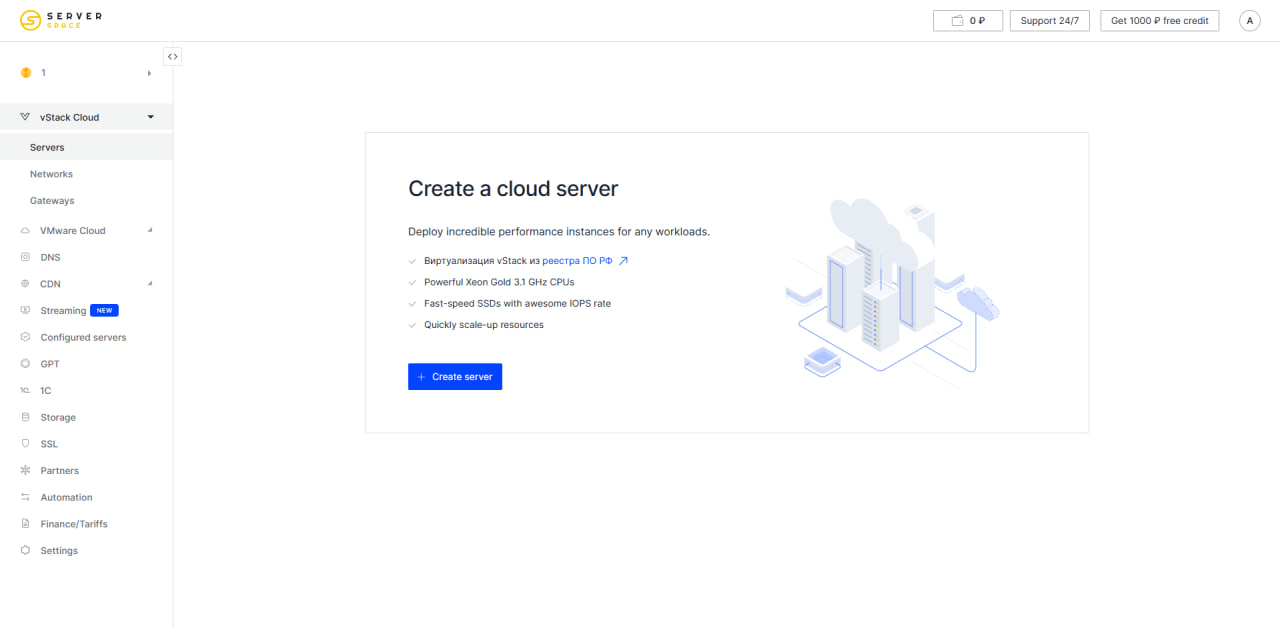
In addition to VMs, the panel also supports additional services such as S3, CDN, SSL, DNS, and VPN. It also allows you to manage external services, including Kubernetes and VMware vSphere.
The pay-as-you-go model within vStack SPP allows you to pay based on actual resource usage, making it easier for providers to get started without significant upfront costs.
What to consider when launching a service
The cost of launching a cloud is determined not only by the server base and hypervisor, but also by how quickly the provider integrates the infrastructure with accounting, pricing, and billing.
If there is a gap between these points, the launch is delayed, and the first revenue comes in later. If the system is integrated from the start, the cloud begins to operate as a business.

Next step
When launching or rebuilding a cloud service, it is important to evaluate not only the resource base but also how it is integrated with accounting and billing.
It is this integration that determines manageability, predictability, and time-to-market.
Learn more about the program for service providers and connection terms: https://vstack.com/spp/
Telegram
Facebook
Instagram
Twitter